
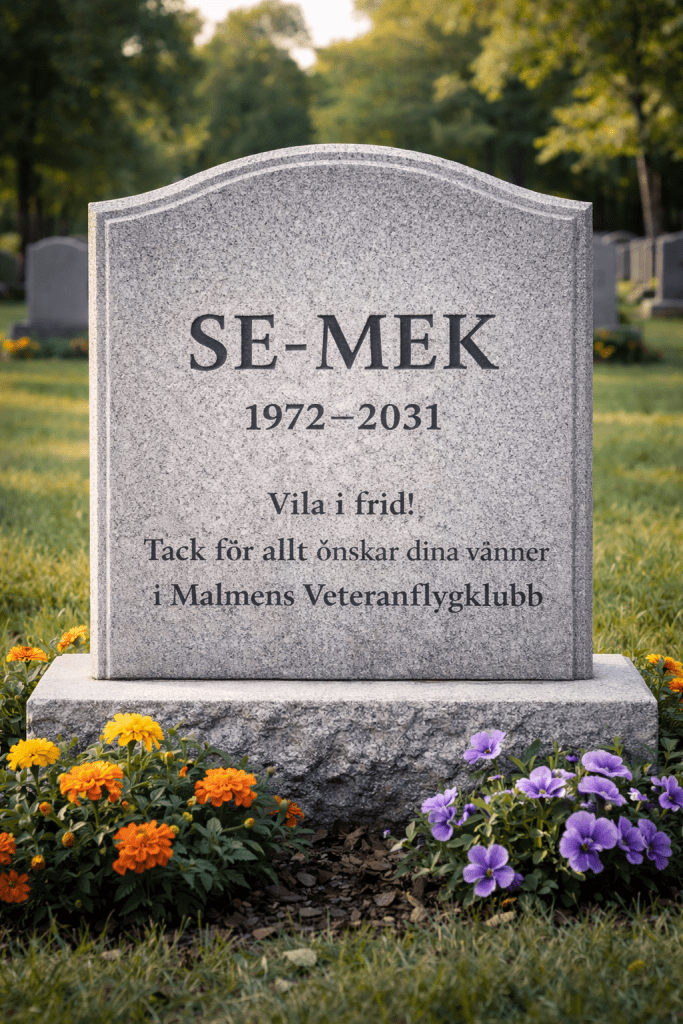
Vi har idag flugit 4282 h med SE-MEK. Det finns en SB ute för livstidsförlängning vid 5000 h. Vi har i klubben sagt att den är för dyr att genomföra. Nu har dessutom de Havilland gjort följande uttalande:
”Thank you for your message regarding inspection of the Scottish Aviation Bulldog and the associated Fatigue Life limitations.
I believe my colleague, Emma, explained our publications to you and I will attempt to explain our position regarding Bulldog fatigue life.
Despite the 5,000 flying hour life of the Bulldog appearing conservative, when compared to aircraft where a Fatigue Meter was fitted to monitor fatigue consumption, the process of gaining an extension to the life is far from straightforward, even where records are available detailing the type of operation back to the birth of the aircraft.
As you will see from Bulldog Service Letter BDG/1/2004, Issue 2, the airframe life is based on a Full-scale Fatigue Test – i.e. a test to destruction of the spar – with a conservative safety factor applied.
Only once have we managed to obtain an extension to the fatigue life. This was a time consuming and expensive exercise, which we carried out to allow an operator to continue flying three high-time aircraft until modification kits were available. As you will see from the attached Airworthiness Approval Note, we only gained them 88 flying hours, after a lot of effort and expense processing a Major Modification. Shortly after that, the owner exported all three machines to the U.S. and replaced his fleet with Extra 300s!
Despite having extensive fleet flying hours data and Fatigue Meter data from ex-Royal Air Force aircraft, we have made a firm decision not to issue any further extensions to the published life limitation, for various reasons. Obviously, liability is one issue, as with documented failure data from a fatigue test, we would have a hard time convincing our regulator or insurer to endorse anything other than a very minor increase in life. Probably the biggest factor is that unlike Cessna and Piper, we only have one full time member of technical staff and two others (myself included) working on a part-time basis, responsible for an extremely large and disparate fleet of aircraft. We really have to concentrate more on the fleet rather than individual aircraft if we are to survive.
On a more positive note, we previously produced a batch of five BH.193 Modification kits, to extend Bulldog airframe life, with four successfully embodied and one work in progress, by two different maintenance organisations in the U.K. Unfortunately, some important components were damaged whilst trying to jig-drill holes and so the final kit of parts is incomplete. We intend to manufacture more in the future but after large financial investment in other components, including modified Bulldog replacement control column handgrips [not subject to the AD requiring replacement], we have to let the bank balance recover prior to thinking about further production.
We have plans to get more BH.193 kits produced in the future but have committed our limited funds to other fleet improvement modifications and so need to see a return from those before we can invest in manufacture of new parts. In addition to the main structural components, there are literally hundreds of standard parts to source, including small quantities of a large range of NAS 1/64th oversize repair bolt part numbers. Nobody wants to sell these in small quantities, so the capital outlay is likely to be large. Since we previously manufactured kits, the cost of raw materials and production has increased dramatically, so we are reluctant to even attempt to give a ballpark figure for the parts. To compound the problems, the last subcontractor we used went into liquidation, resulting in the loss of tooling and drawings. Whilst not impossible to press ‘go’ and start again, you can see that it is not a straightforward process. When we do get around to commencing production again, it is likely that we will require a significant down payment to show commitment from aircraft owners.
Another hurdle to jump is a way to embody BH.193 overseas. Whilst embodiment is not particularly difficult, considerable expertise in aircraft structural work is essential. We were very careful which organisations we allowed to carry out the modification over here, as there is potential to damage the aircraft beyond economic repair if a mistake is made. We also have a complete kit of specialist tooling, including modified reamers, drilling jigs etc. These items are essential for embodiment and you would be difficult to manufacture locally.
I am sorry I couldn’t give or more positive answer to solve your immediate problem. Our desire to assist sometimes far exceeds our ability to do so!”
Så även om vi hade beslutat att genomföra modifieringen så verkar det vara svårt att få tillgång till rätt moddmaterial.
Ca 720 h kvar. Vi flyger ca 100-150 h/år. D.v.s. ca 5 år kvar innan det är dags för byte av flygplan. Sedan kan givetvis andra saker inträffa som t.ex. att något hittas under en sprickundersökning.
 MVFK
MVFK 